
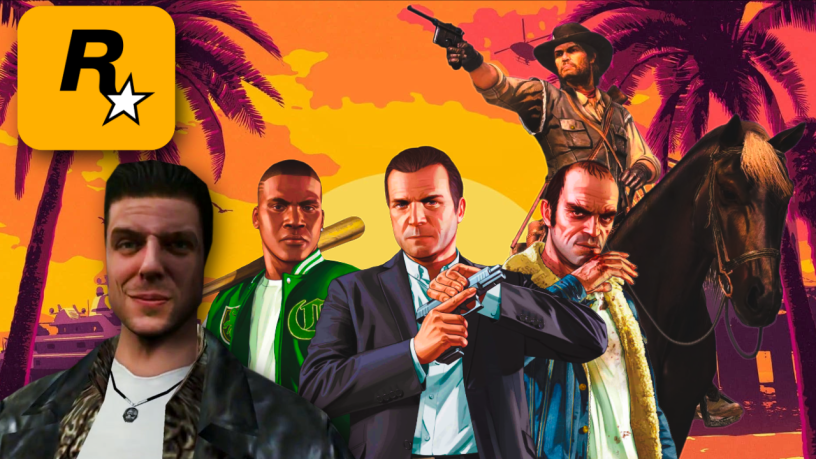
Rockstar Games is more than just a video game developer — it’s one of the most influential forces the industry has ever seen. Since the late 1990s, Rockstar has consistently pushed boundaries with massive open worlds, cinematic storytelling, controversial themes, and a level of polish that few studios can rival. Whether you love them for their crime epics, unforgettable characters, or attention to detail, Rockstar titles tend to dominate conversations years — sometimes decades — after release.
In this in-depth ranking, we’re breaking down the 10 best Rockstar Games of all time, counting from the bottom up to build toward the studio’s absolute pinnacle. This list considers cultural impact, gameplay innovation, storytelling, replay value, and long-term legacy. Some rankings may spark debate — and honestly, that’s part of the fun.
Let’s dive in.
#10 – Max Payne (2001)
Before Rockstar became synonymous with sprawling open worlds, Max Payne showed the studio’s commitment to dark, mature storytelling. Developed by Remedy Entertainment and published by Rockstar Games, Max Payne introduced bullet time mechanics to mainstream gaming, forever changing how third-person shooters felt and played.
The game follows Max Payne, a New York City detective whose life spirals into tragedy after the brutal murder of his family. What unfolds is a gritty neo-noir revenge story told through comic book–style panels, internal monologues, and atmospheric urban environments. At the time, this narrative approach felt bold and cinematic, setting a new standard for story-driven action games.
Gameplay-wise, Max Payne emphasized precision gunplay and stylish slow-motion dives that made every shootout feel choreographed. While later Rockstar games would far surpass it in scale, Max Payne remains one of the most influential shooters ever made and a crucial piece of Rockstar’s legacy.
#9 – Bully (2006)
Few games capture adolescence quite like Bully. Released amid controversy, Bully took Rockstar’s open-world formula and applied it to a boarding school setting — and somehow made it work beautifully. Rather than glorifying crime, the game focuses on teenage rebellion, social hierarchies, and growing up.
You play as Jimmy Hopkins, a troubled teen navigating life at Bullworth Academy. The open world may be smaller than GTA, but it feels incredibly alive. Classes follow schedules, students react dynamically to your actions, and each clique has its own personality and rivalries.
What makes Bully special is its tone. It’s funny without being cruel, rebellious without being nihilistic, and surprisingly heartfelt beneath the satire. Over the years, Bully has become a cult classic, with fans still hoping for a long-overdue sequel. Its originality alone earns it a well-deserved spot on this list.
#8 – L.A. Noire (2011)
L.A. Noire stands as one of Rockstar’s most ambitious and experimental projects. Set in 1940s Los Angeles, the game shifts focus away from chaotic action and toward detective work, investigation, and interrogation.
The standout feature was its revolutionary facial animation technology, which allowed players to read suspects’ expressions during questioning. This mechanic added a layer of realism rarely seen in games at the time and made every interrogation feel tense and engaging.
Narratively, L.A. Noire tells a slow-burn crime drama inspired by classic film noir. While its open world is more of a backdrop than a sandbox, the attention to historical detail and storytelling makes the experience unforgettable. Though divisive among fans, L.A. Noire proved Rockstar could succeed outside its traditional formula.
#7 – Midnight Club: Los Angeles (2008)
Rockstar doesn’t just excel at open-world action — it has also delivered one of the finest arcade racing franchises ever made. Midnight Club: Los Angeles represents the series at its absolute peak.
Featuring a highly detailed recreation of Los Angeles, the game emphasizes speed, customization, and skill-based racing. Unlike traditional track racers, Midnight Club encourages players to navigate traffic-filled city streets at blistering speeds, memorizing shortcuts and mastering timing.
The sense of velocity remains unmatched even today, and the progression system keeps players hooked for hours. While the franchise has been dormant for years, Midnight Club: Los Angeles remains one of Rockstar’s most underrated achievements.
#6 – Red Dead Redemption (2010)
When Red Dead Redemption launched, it proved that Westerns could thrive in modern gaming. Set in the dying days of the American frontier, the game follows John Marston, a former outlaw forced to hunt down members of his old gang.
Rockstar San Diego crafted a vast open world filled with wildlife, random encounters, and morally complex characters. The pacing, music, and atmosphere all contribute to a melancholic tone rarely seen in action games.
John Marston’s story is tragic, compelling, and unforgettable. Red Dead Redemption laid the foundation for what would later become one of the most celebrated sequels of all time.
#5 – Grand Theft Auto III (2001)
Few games have changed the industry as dramatically as Grand Theft Auto III. By bringing open-world crime into full 3D, Rockstar revolutionized game design almost overnight.
Liberty City felt alive in a way few games ever had before. Players could ignore missions, cause chaos, or simply explore — a level of freedom that was unheard of at the time. Nearly every open-world game released since owes something to GTA III.
Despite its aging mechanics, the game’s impact and innovation secure its place among Rockstar’s greatest titles.
#4 – Grand Theft Auto: Vice City (2002)
Vice City refined everything GTA III introduced and drenched it in neon-soaked 1980s style. From its unforgettable soundtrack to its charismatic protagonist, Tommy Vercetti, the game oozes personality.
The storytelling was sharper, the missions more varied, and the world more vibrant. Vice City proved Rockstar could blend strong narratives with open-ended gameplay — a formula the studio would continue to perfect.
#3 – Grand Theft Auto V (2013)
Grand Theft Auto V is a technical and commercial phenomenon. Featuring three playable protagonists and a massive open world, the game pushed the boundaries of what was possible on console hardware.
Los Santos is one of the most detailed virtual cities ever created, filled with satire, secrets, and side activities. GTA Online further extended the game’s lifespan, turning it into one of the most profitable entertainment products of all time.
#2 – Red Dead Redemption 2 (2018)
A triumph of storytelling and immersion, Red Dead Redemption 2 is Rockstar at its most ambitious. The game’s attention to detail is staggering — from dynamic weather to character interactions that feel startlingly human.
Arthur Morgan’s emotional journey is widely regarded as one of the greatest character arcs in video game history. While slower-paced than many action games, RDR2 rewards patience with unmatched depth and realism.
#1 – Grand Theft Auto: San Andreas (2004)
At the top of the list stands Grand Theft Auto: San Andreas — Rockstar’s most complete and beloved experience. Featuring an enormous map, RPG-style mechanics, and a powerful story inspired by 1990s West Coast culture, San Andreas did everything — and did it well.
Carl “CJ” Johnson’s journey through gang warfare, corruption, and family loyalty remains iconic. The game offered unprecedented freedom, customization, and replayability, cementing its place as the definitive Rockstar title.
Ranking the best Rockstar Games of all time is no easy task, but these ten titles represent the studio’s most influential, ambitious, and unforgettable works. From groundbreaking open worlds to emotionally powerful narratives, Rockstar’s legacy is unmatched in gaming history.
Whether you grew up causing chaos in San Andreas, roaming the frontier in Red Dead Redemption 2, or discovering cult classics like Bully, one thing is clear — Rockstar Games continues to shape the industry in ways few developers ever have.
 Fantastic Nerdom