
The 1990s weren’t just an important decade for first-person shooters — they were the decade that created the genre. Before cinematic campaigns, battle passes, and esports arenas, FPS games were raw, experimental, and wildly creative. Developers were inventing the rulebook as they went, and players were discovering an entirely new way to experience video games.
This was the era of shareware disks, LAN parties, CRT monitors, and mouse-and-keyboard dominance. Level design was king, soundtracks were legendary, and mods turned single games into entire ecosystems. Many of today’s biggest franchises still rely on ideas born during this decade.
These are the top ten first-person shooters of the 1990s — the games that built the foundation for everything that came after.
10. Star Wars: Dark Forces (1995)
Before cinematic Star Wars games were the norm, Dark Forces proved that the galaxy far, far away could thrive in first-person form. Developed by LucasArts, this game introduced mechanics that were groundbreaking at the time, including jumping, crouching, and true vertical level design.
Unlike many shooters of the era, Dark Forces focused heavily on exploration. Levels were massive, maze-like, and full of secrets. The game also featured objectives beyond simply reaching the exit, which added depth and immersion rarely seen in early FPS titles.
Most importantly, it respected the Star Wars universe. The weapons, environments, and story felt authentic, making Dark Forces one of the earliest examples of a licensed FPS done right.
9. GoldenEye 007 (1997)
When GoldenEye 007 launched on the Nintendo 64, it shattered expectations. At a time when PC shooters dominated the genre, GoldenEye proved that FPS games could work — and thrive — on consoles.
The single-player campaign featured varied objectives, stealth mechanics, and difficulty-based mission changes. But its true legacy lies in its multiplayer. Four-player split-screen matches became legendary, defining friendships, rivalries, and countless late-night gaming sessions.
GoldenEye helped bridge the gap between PC and console shooters, influencing future FPS controls, level design, and multiplayer structure.
8. System Shock (1994)
System Shock was years ahead of its time. Rather than focusing purely on action, it blended shooting with RPG mechanics, environmental storytelling, and player choice. The game placed players aboard a space station controlled by the terrifying AI SHODAN, one of gaming’s most iconic villains.
Exploration was key. Audio logs, environmental clues, and emergent gameplay rewarded players who paid attention. It wasn’t always easy to play, even by ’90s standards, but its ambition was unmatched.
System Shock laid the groundwork for immersive sims and heavily influenced later classics like Deus Ex and BioShock.
7. Duke Nukem 3D (1996)
While other shooters took themselves seriously, Duke Nukem 3D leaned hard into personality. Packed with one-liners, pop culture references, and interactive environments, Duke brought attitude to the genre.
Levels felt alive. Toilets flushed, mirrors reflected, lights shattered, and environments reacted to player actions. Enemies weren’t just targets — they were characters with behavior and voice lines.
Duke Nukem 3D proved that FPS games didn’t have to be sterile or serious to be groundbreaking. Fun, humor, and interaction mattered just as much as firepower.
6. Unreal (1998)
When Unreal arrived, it was visually stunning. Dynamic lighting, massive open environments, and advanced sound design made it one of the most immersive shooters of the decade.
Combat was slower and more deliberate than many of its contemporaries, emphasizing atmosphere and exploration. Alien worlds felt mysterious and dangerous, supported by an unforgettable ambient soundtrack.
Perhaps Unreal’s greatest legacy is its technology. The Unreal Engine would go on to become one of the most important tools in video game development, shaping countless games long after the ’90s ended.
5. Hexen (1995)
Building on the Doom engine, Hexen pushed the FPS genre into darker, more complex territory. It introduced character classes, hub-based progression, and puzzle-heavy level design that required backtracking and problem-solving.
Combat was slower and more tactical, with magic-based weapons and limited resources. Levels felt like dark fantasy labyrinths rather than simple shooting galleries.
Hexen proved that FPS games could evolve beyond pure action and experiment with RPG-inspired systems — a bold move for the mid-1990s.
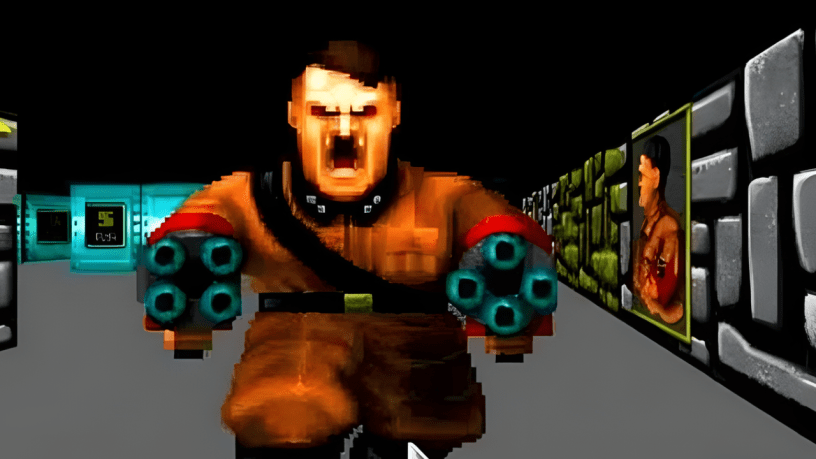
4. Wolfenstein 3D (1992)
Everything starts here.
Wolfenstein 3D established the basic DNA of the FPS genre: fast movement, first-person gunplay, and enemy-filled corridors. It wasn’t complex, but it didn’t need to be. Its simplicity made it revolutionary.
The game’s speed and intensity were unlike anything players had experienced before. It set the stage for Doom, Quake, and the explosion of shooters that followed throughout the decade.
Without Wolfenstein 3D, the FPS genre simply wouldn’t exist as we know it.
3. Quake (1996)
Quake was a massive leap forward. It introduced true 3D environments, vertical aiming, physics-based movement, and online multiplayer that helped define competitive gaming.
Its dark fantasy atmosphere, industrial soundtrack, and brutal combat gave it a unique identity. Mods like Team Fortress and Capture the Flag extended the game’s lifespan and laid the groundwork for modern multiplayer shooters.
Quake wasn’t just a game — it was a platform for innovation, competition, and community.
2. Doom (1993)
Few games in history are as influential as Doom. It popularized deathmatch, modding, and shareware distribution. It ran on everything. It spread everywhere. It became a cultural phenomenon.
Doom’s fast-paced gameplay, iconic weapons, and unforgettable music created an experience that still feels good to play today. The community kept it alive through mods, custom levels, and source ports, ensuring its legacy never faded.
Doom didn’t just define the 1990s — it defined FPS gaming as a whole.
1. Half-Life (1998)
At the top sits Half-Life, the game that changed everything.
Instead of separating gameplay and story, Half-Life merged them. There were no cutscenes — the narrative unfolded naturally as players moved through the world. Enemy AI was smarter, environments were interactive, and pacing felt cinematic without sacrificing player control.
Half-Life raised expectations for storytelling in FPS games and inspired an entire generation of developers. Its modding scene gave rise to Counter-Strike, further shaping multiplayer gaming for decades.
Even today, Half-Life stands as one of the most important video games ever made.
The 1990s were the wild frontier of first-person shooters. Developers experimented fearlessly, players embraced innovation, and the genre evolved at lightning speed. These ten games didn’t just entertain — they built the foundation for modern gaming.
Every reload, every headshot, every multiplayer match today traces its roots back to this era.
 Fantastic Nerdom